




University of Maine Cooperative Extension logo

Highmoor Farm

Information you can use,
research you can trust

Home     Find your county office     Publications     About us     News     Events     Programs     Partners & other resources     UMaine


Highmoor Farm

Related Programs and Resources

Other Links of Interest

County Offices
Find out about workshops and demonstrations in your neighborhood and around the state.

University of Maine Cooperative Extension
Highmoor Farm

PO Box 179
52 U.S. Route 202
Monmouth, ME 04259-0179
Phone: (207) 933-2100
TDD:  1-800-287-8957 (in Maine)
Fax: (207) 933-4647

E-mail: cehmf@umext.maine.edu


Offic
e Hours:  weekdays from 7:00AM to 3:30PM

Muskmelon Evaluations 2007-2008

University of Maine Highmoor Farm

Mark Hutton (mhutton@umext.maine.edu)
David Handley (dhandley@umext.maine.edu)

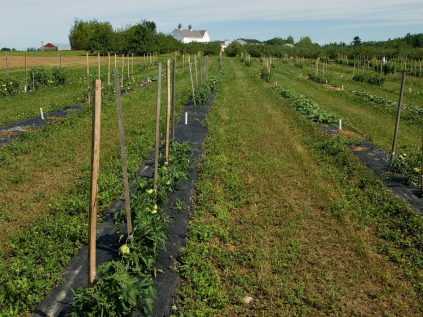
During the last few years a number of new muskmelon cultivars have been released that had not been tested in New England Universities variety trials. In this experiment we evaluated the performance of 18 muskmelon cultivars (Table 1.) and their response to PlantShield®. PlantShield® is a beneficial fungus that actively grows on plant roots protecting the roots from attack by many common root pathogens, thereby, increasing the overall health of the plant. The experiment was set out in a randomized complete block with split-plots and four replications at University of Maine Highmoor Farm, Monmouth, ME. Individual plots consisted of 10 plants split into sub-plots with half the plants receiving the treatment. The PlantShield® treatment was applied as a drench, 500 ml per plant of a 3 oz PlantShield® / 100 gal solution in combination with starter fertilizer. The check treatments received only the starter fertilizer. Transplants were seeded, May 14, 2007 and May 20, 2008. Transplanting dates were June 9, 2007 and June 4, 2008. Soil tests were taken and pre-plant fertilizer was incorporated prior to laying plastic mulch. Sandea (3/4 oz A.I.) was applied after transplanting to control weeds. The melons were harvested at ½ slip and harvest occurred three times per week. All fruit were individually weighed, rated for flesh color and quality, and brix measurements taken.

Results

The application of PlantShield® had no effect on plant health, fruit yield or quality. There were significant differences in maturity, fruit yield, and quality among the cultivars evaluated. Goddess was the earliest cultivar with the mid-harvest point 100 days after seeding while Athena, the latest maturing cultivar, reached the mid-harvest point approximately two weeks later (Table 1). Maverick produced significantly more fruit than any other cultivar during the two years of testing. All the cultivars tested developed acceptable levels of sugars when averaged over all harvested fruit (Table 2).  Sarah’s Choice, Maverick, and Wrangler consistently produced the sweetest most flavorful fruit.

Table 1. Yield summary of muskmelons grown at University of Maine’s Highmoor Farm during the 2007 and 2008 growing season.

Cultivar

Avg. num. of
fruit per plant

Avg. fruit wt (lbs)

Days to mid-harvest

Maverick

3.5

a

2.4

e

106

bc

Strike

2.5

 b

3.4

 b-d

112

ab

Wrangler

2.3

 b

2.5

e

111

ab

Sarah's Choice

2.2

 b

3.0

de

105

bc

Earliqueen

2.2

 b

2.7

e

107

bc

Goddess

2.1

 b

3.8

a-c

100

c

RockStar

2.0

 b

4.4

a

109

ab

Diva

2.0

 b

4.0

ab

110

ab

Eclipse

1.9

 b

3.3

cd

113

ab

Athena

1.8

 b

3.8

bc

115

a

LSD (0.05)

0.97


0.6


8.24


Table 2. Fruit characteristics of muskmelons grown in the 2007 and 2008 growing seasons at University of Maine’s Highmoor Farm

Cultivar

Brix

Fruit Shape

Netting

Sutures

Flesh Thickness (cm)

Flesh Color

Sarah's Choice

11.5

a

2.2

bc

2.4

de

1.5

cd

3.24

a-d

1.8

a-c

Maverick

11.5

a

2.9

a

3.4

bc

2.8

b

2.86

d

1.8

a-c

Wrangler

11.0

ab

1.8

c-e

3.9

ab

3.8

a

2.84

d

2.2

bc

Goddess

10.5

ab

2.0

b-d

2.1

e

1.5

cd

3.79

a

1.8

a-c

Eclipse

10.5

ab

2.3

b

4.0

ab

2.0

bc

3.09

b-d

2.6

c

Athena

10.4

ab

1.8

de

4.2

a

2.1

bc

3.23

b-d

1.8

bc

Earliqueen

10.1

ab

3.0

a

3.7

ab

3.9

a

2.99

d

1.6

a

Diva

10.1

ab

1.5

e

3.8

ab

1.5

cd

3.24

b-d

2.3

bc

RockStar

9.9

b

1.7

de

3.0

cd

2.1

bc

3.66

ab

1.7

ab

Strike

9.7

b

1.6

de

2.9

cd

0.9

d

3.56

a-c

2.4

c

LSD (0.05)

1.5


0.4


0.7


0.8


0.549


0.7


Fruit Shape: 1 – elongated oval, 2 – oval, 3 – round, 4 – flat round
Netting: 1 smooth – 5 very course
Sutures: 1 no sutures – 5 deep sutures
Flesh Color: 1 light – 3 dark

Brief Descriptions

Sarah's Choice: Round/ oval shape, distinctive green tint in rind, fine net, slight suture, excellent flavor, PM 1,2; Fus 0,1,2

Maverick: Excellent flavor, firm flesh, fairly course net, prominent suture, very strong plant, PM 0,2; Fus 1,2

Wrangler: Oval fruit with very prominent green suture, excellent flavor, high yields, PM 1,2; Fus 0,1,2

Goddess: Early, firm flesh with small cavity, green tint in rind, medium fine net, slight suture, excellent flavor, musky, PM 0,1,2; Fus 1,2

Eclipse: Slightly oval, medium net, slight suture, some with large open cavity, range of flesh color, fair flavor, PM 1; Fus 2

Athena: Late, large fruit, very slight suture, firm flesh, fruit holds well, PM 1,2; Fus 0,1,2

Earliqueen: Oval to round, deep sutures, course net, small cavity, good flavor and sugars, short harvest period, tends to be soft, no disease tolerance/resistance

Diva: Slightly oblong, green tint in rind, medium net, slight suture, bland, PM 1,2; Fus 0,1,2

RockStar: Slightly oblong, light flesh color, medium net, slight suture, poor flavor, PM 0,1,2; Fus 1,2

Strike: Oval, medium net, slight suture, fair flavor, wide range of brix values, nice flesh color, tight cavity, PM 1,2; Fus 0,1,2


University of Maine crest artLast Modified: 09/25/09 | Accessibility | Non-discrimination & Disability Resources | Disclaimer | Photo Credit | Copyright |

A Member of the University of Maine System