


Trickle
Irrigation
Using and
Conserving Water in the Home Garden
Prepared by Mark
Hutchinson, Extension educator
| University of Maine Cooperative Extension Bulletin #2280 |
Although
Maine normally receives ample annual precipitation, July and August can be very
dry. Long periods of dry weather may appreciably
reduce the yield of a home
garden. The critical time for vegetable production often coincides with our
driest weather. Your plants need from one to
two inches of water per week during
the growing season for best production. Many gardeners help maintain soil
moisture by mulching, hand
weeding or adding organic matter. During extended dry
periods these cultural practices may not be enough, so additional water may be
required.
Proper watering techniques will conserve water.
Water is typically lost in three ways when applied to home gardens:
By watering the right amount, at
the proper time, and in the most effective way, you can conserve water and
improve plant health. Trickle or
“drip” irrigation is one of the most efficient
methods of applying water in the home garden.
What is Trickle Irrigation?
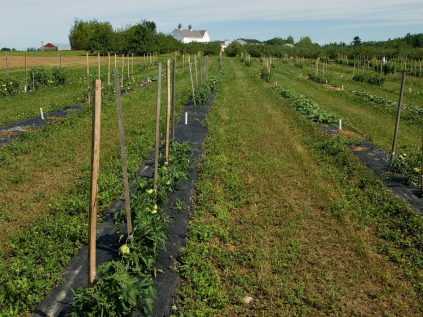
Trickle irrigation, sometimes referred to as drip irrigation, is a low-pressure system that places water slowly and directly in the root zone of the desired plant, increasing the efficiency of the water applied. Trickle irrigation can reduce water usage by 30 to 70 percent compared to more traditional means of irrigation, such as overhead sprinklers or hand watering.
Trickle irrigation systems are
operated at pressures between five and 15 pounds per square inch (PSI). Drip
tape or trickle tubes are usually laid to the side of the
plant row or between
two rows.
Water seeps through small emitters that permit water to flow out of the
pipe at a very slow rate. Emitters are located every four to 24 inches along the
drip tape,
depending on the desired wetting pattern and plant spacing.
Benefits of Trickle Irrigation
Disadvantages of Trickle Irrigation
Frequently Asked Questions About Trickle Irrigation
How expensive is a trickle irrigation system?
What can I use as a water source for trickle irrigation?
How do I know when my garden needs to be irrigated?
How do I determine what type of system is best for me?
Irrigation systems can be
designed to fit almost every need. Determining the best system for your
situation requires knowledge of your site,
water requirements, water
availability
and planning. See the resources below to help you plan your system.
Resources
Broner, I. Drip Irrigation for Home Gardens. Colorado State University Cooperative Extension publication 4.702 (1998).
Order from Colorado State University Cooperative Extension, 1 Administration Building, Colorado State University,
Fort Collins, CO 80523-4040. As of 6/13/03 available at http://www.ext.colostate.edu/pubs/garden/04702.html
Drinkwater, W. O. and H.E.
Carpenter.
Trickle Irrigation for Home Gardens. Rutgers University (reviewed 1994).
As of 6/13/03 available at
http://www.cce.cornell.edu/suffolk/grownet/home-gardening-general/trickle.html
VanDerZanden, A.M. Conserving
Water in the Garden: Designing and Installing a New Landscape. Oregon State
University Extension Service
publication EC1530 (2001).
Order from Publication Orders, Extension and Experiment Station Communications, Oregon State University, 422 Kerr Administration, Corvallis, Oregon, 97331-2119
1-800-561-6719. Also available online as of 6/13/03 at http://eesc.orst.edu/ agcomwebfile/ edmat/html/ec/ec1530/ ec1530.html
For more information, contact your county Extension office.
Published and
distributed in furtherance of Acts of Congress of May 8 and June 30, 1914, by
the University of Maine Cooperative Extension,
the Land Grant University of the
state of Maine and the U.S. Department of Agriculture
cooperating. Cooperative
Extension and other agencies of the U.S.D.A. provide equal opportunities in
programs and employment.
Return to Publications Catalog Online
Table of Contents
Return to Publications Homepage
Putting knowledge to work with the people of Maine

A Member of the University of Maine System
Last Modified:
08/12/08
These pages are currently being maintained from the
Communications Office, University of Maine Cooperative Extension.
Send comments, suggestions or inquiries to
www-questions@umext.maine.edu
COUNTY OFFICES | PROGRAMS | RESOURCES | PUBLICATIONS | NEWS AND EVENTS | UMAINE EXTENSION HOME | UMAINE