





To print a copy, we recommend downloading the (PDF) print version. (Download the free Adobe Acrobat Reader, if you need it.)


University of Maine Cooperative Extension
Bulletin #2701

  drawing of flowering plant
Landscapes for Maine
Designing Your Landscape for Maine
Developed by Kirsten Reberg-Horton, landscape designer, in collaboration with Lois Berg Stack, Extension ornamental horticulture specialist, and Laura Wilson, Extension assistant scientist.

Your landscape is a place that is extremely personal to you. You may work, play, entertain, or simply relax in it. But your landscape is also a place that is “personal” to all the people, animals, and plants that live in Maine! It may seem hard to believe, but what you do, even on a tiny urban lot, has an effect—positive or negative—on the overall health of our Maine environment.


This bulletin provides easy steps to help you design a landscape that is beautiful, functional, and positive for our shared environment. As you follow each step, the layered information that your property holds will be revealed to you—like peeling an onion! This information will help you identify the best possible uses and choose the best possible plants for your particular corner of Maine.
 

Landscapes for Maine
Would you like to know more about landscaping practices that are good for Maine? Ask your county Cooperative Extension office for these publications, or find them at http://extensionpubs.umext.maine.edu
Gardening to Conserve Maine's Landscape: Plants to Use and Plants to Avoid, bulletin #2500
Native Plants: A Maine Source List, bulletin #2502

Throughout your process, don’t get overwhelmed. Remember, Rome really wasn’t built in a day, and your landscape may take years to mature or develop into what you dream it can be. Your landscape truly can become a place that satisfies your desires for beauty or usefulness while also respecting and nurturing our natural resources.

Step 1: Plot Your Property

Look through your records. Did you receive a lot plan that shows your home in relation to the property boundaries? If you did, you can use that plan as the basis for your design.

If you were not so lucky, carefully measure and plot the portion of your property for which you are doing this design.

For your base map, you want to be sure to properly measure and place

Step 2: Analyze Your Property

The first part of property analysis is soil testing. Contact your county Extension office for a soil test kit and follow the directions carefully. The type of soils that you have will greatly affect the kinds of plants you will choose for your property. Be sure to test different kinds of places on your property independently. For example, if you have both a sunny, dry front lawn and moist woodland, don’t combine them! When you receive the results of your soil test, include them with the rest of your analysis.

Another part of your analysis will be finding out about local codes and covenants. It’s important to know what restrictions or requirements exist for the type of project you are planning.

Finally, tape a sheet of tracing paper over the top of your base map and go out into your landscape. (You may end up needing several sheets of paper.) With different colored pencils, note the following:

We will be using the to-scale plan or “base map” of your property many times. You will either want to obtain several photocopies of it, or you will need tracing paper that you can mark on over the top of your base map. Tracing paper is useful as it allows you to consider many different elements at the same time.

Step 3: Brainstorming

Sit down with the people who use your property the most (spouse, office mates, children, clients) and brainstorm current and future uses. Here are some questions you may wish to ask.

When you complete your brainstorming, condense it into a list of needs. Prioritize those needs by how important they are and how soon you will try to fill them.

Step 4: Bubble Design

Now that you have completed your list of needs, it’s time to take your base map back out and overlay it with the analysis and a fresh sheet of tracing paper. You are ready to begin your bubble design. Bubble designs are the first stage of landscape planning, and are a quick way to work with ideas before you start focusing on the details of the design. This is the time when you “bubble out” general areas of use. After analyzing your soils, sun, shade, water, etc., you should be ready to decide which areas will be best for different needs.

Many designers use a zone system when they are in this stage of design. By drawing concentric circles around the center of activity in your plan (e.g. home, office, school), you can place daily activities in zone one, less frequent activities in zone two and so on.

Another thing to think about in bubble designing is transitions. You need to plan (and allow space for) how you will move from one area to another.

A bubble design should be general, but should place each use or need on your plan, and give it an approximate location. It’s a great idea to be really creative at this stage of designing. Do three or four bubble designs. Try “wacky” ideas and then narrow down to the one that most closely matches your needs.

Step 5: Detailed Design

A detailed design will include exact sizes and shapes of paths, beds, patios, lawns, and other elements.

After completing your bubble designs, it’s time to get out your ruler and start thinking about the sizes and shapes of the different areas in your design. A detailed design will include the following:

The following common outdoor items take up space. Here is a general set of guidelines.*

* John E. Collins and Marvin L. Adleman, Livable Landscape Design (Cornell Cooperative Extension, 1988), p. 29.


 Plant Selection

When choosing a plant for any location in the landscape, the first thing to do is select the size. A common guideline is to put large plants in the back, middle-sized plants in the middle, and short plants in the front. This is called stacking. Stacking can be done in small flowerbeds and across broad landscapes. If you have a backyard that borders a forest, you may wish to stack down from the tall trees in the woods with smaller ornamental trees, then shrubs, then perennials, then lawn. As you do your detailed design, draw in plant sizes before you do plant selection.
Only after you have done that, should you begin considering the other factors in plant selection:
hand drawing of asters

  • Zone
  • Sunlight
  • Moisture
  • Season (There are plants that provide interest through all four seasons; code your plan to indicate plants that will shine in spring, summer, winter and fall.)
  • Native/nonnative
  • Soil type
  • Color
  • Texture
  • Scent
  • Utility (whether a plant provides food for birds/wildlife or is edible, deer-resistant, or good for making baskets—or marshmallow sticks!)

Once you have gone through this list for each plant specified in your design, you should know exactly what kind of plants to look for. You can make a detailed shopping list for your trip to the nursery!


drawing of butterfly Keep Your Plan Maine-Friendly

  • Include a rain garden in your plan. Rain gardens capture the water from impermeable surfaces on your property and allow it to slowly filter into the groundwater. These gardens prevent fast-moving runoff and are beautiful assets to your landscaping.1
  • Install gutters and rain barrels on your house, barn or garage. A rain barrel can provide natural rainwater irrigation for your gardens.
  • If you live on or near a body of water, develop a complete buffer design for your property. Buffers slow and filter water. Elements of buffer plantings are trees, shrubs, perennials, and duff or mulch layers. (These are also the elements of any ecological landscape design.) The root systems of your plantings will capture water, the leaf canopy will reduce the erosive impact of raindrops on your soil, and the duff layer will improve infiltration of rainwater and reduce the effects of drought on your plantings. Using native plants in your buffer helps your waterside property to fit naturally into its environment. Even well-manicured and highly formal gardens can be planted with native plants that give your property a place-centered appeal rather than looking like “anywhere suburbia.”
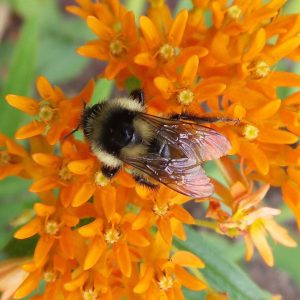
  • Plant for wildlife. Trees and shrubs provide food and habitat for birds and small mammals. Many flowers attract hummingbirds, butterflies, and other pollinators.
  • Replace your lawn with low-maintenance ground-covers or a natural meadow. Carefully plan how much lawn you really need and fill other areas with low shrubs, trees, groundcovers, or flower or vegetable beds. Lawns are not efficient at filtering and slowing rainwater, and they tend to be highly compacted. Reducing your lawn size not only means less maintenance, it also means less water runoff from your property.
  • Include native plants in your design. By their very definition, native plants have evolved to be successful in Maine. There are beautiful native plants for every situation in your landscape: wet shade, dry sun, dry shade, wet sun. Using native plants helps you in many ways. By selecting a plant that is uniquely suited to Maine’s climate and conditions, you are taking an important step in ensuring that your plant will be healthy. You are also taking a valuable step towards helping to preserve the character of Maine.


Web Design by Linda Reed, editing by Melanie Spencer.


1 For information on rain gardens, contact Rain Gardens of West Michigan, West Michigan Environmental Action Council, 1007 Lake Drive SE, Grand Rapids, MI 49506, 616-454-RAIN. Or visit http://www.raingardens.org

Published and distributed in furtherance of Acts of Congress of May 8 and June 30, 1914, by the University of Maine Cooperative Extension, the Land Grant University of the state of Maine and the U.S. Department of Agriculture cooperating. Cooperative Extension and other agencies of the U.S.D.A. provide equal opportunities in programs and employment.


Return to Publications Catalog Online Table of Contents
Return to Publications Homepage


Putting knowledge to work with the people of Maine

The University of Maine Cooperative Extension logo

A Member of the University of Maine System
Last Modified: 01/30/08
These pages are currently being maintained from the
Communications Office, University of Maine Cooperative Extension.
Send comments, suggestions or inquiries to www-questions@umext.maine.edu


COUNTY OFFICES | PROGRAMS | RESOURCES | PUBLICATIONS | NEWS AND EVENTS | UMAINE EXTENSION HOME  | UMAINE

Information in this web site is provided purely for educational purposes. No responsibility is assumed for any problems associated with the use of products or services mentioned in this web site. No endorsement of products or companies is intended, nor is criticism of unnamed products or companies implied.