


| To print a copy, we recommend downloading the (PDF) print version. (Download the free Adobe Acrobat Reader, if you don't already have it.) |
University
of Maine Cooperative Extension
Bulletin #4198
Facts
on Fiddleheads
Originally
developed by Extension Professor Mahmoud El-Begearmi.
Revised and updated by Food Science Professor Alfred Bushway, Extension Food
Science Specialist Beth Calder, and Extension Professional David Fuller.
![]() |
![]() |
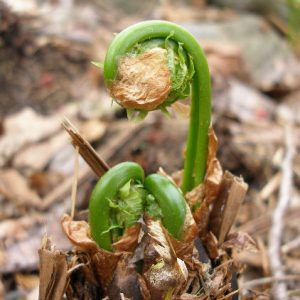
| Ostrich fern fiddleheads have a papery brown covering. Their stems are smooth, with a deep ”U”-shaped groove on the inside. Photos by David Fuller |
Fiddleheads, an early spring delicacy in Maine, are the young coiled leaves of the ostrich fern (Matteuccia struthiopteris). Nearly all ferns have fiddleheads, but those of the ostrich fern are unlike any other. Ostrich fern fiddleheads, which are about an inch in diameter, can be identified by the brown papery scale-like covering on the uncoiled fern, as well as the smooth fern stem, and the deep ”U”-shaped groove on the inside of the fern stem. Look for ostrich ferns emerging in clusters of about three to twelve fiddleheads each on the banks of rivers, streams, and brooks in April and May. Make sure that you have landowner permission before harvesting fiddleheads.
Harvest the tender little rolls of ostrich fern as soon as they are an inch or two above the ground. Carefully brush off and remove the papery brown scales. Thoroughly wash fiddleheads in clean, potable water several times until the wash water appears clean. Then bring a small amount of lightly salted water to a boil, add washed fiddleheads, and cook them at a steady boil for 10 minutes. Fiddleheads can also be washed clean and steamed for 20 minutes. Serve at once with melted butter or vinegar. The sooner they are eaten, the more delicate their flavor. They may be served, like asparagus, on toast. Cooked, chilled fiddleheads can be also served as a salad with an onion and vinegar dressing.
Due to the short season for fiddleheads, some people like to preserve them for later use. To freeze fiddleheads, clean them as you would for the table. Blanch a small amount at a time for two minutes in 4 to 6 cups of water. Cool and drain in cold water or in an ice water bath (half water and half ice). Pack into moisture- and vapor-proof containers and freeze. Thaw and boil for 10 minutes before serving.
Remember to keep fiddleheads refrigerated until you are ready to cook or preserve them. Because process times have not been established for home-preserved fiddleheads, we do not recommend pressure canning as a method to preserve fiddleheads.
Many people are interested in pickling fiddleheads. In cooperation with the Department of Food Science and Human Nutrition at the University of Maine, UMaine Extension staff have tested some pickling recipes for fiddleheads. The most successful of these in terms of flavor, keeping quality, and safety are included in this fact sheet.
The Centers for Disease Control (CDC) has investigated a number of outbreaks of food-borne illness associated with fiddleheads. The implicated ferns were eaten either raw or lightly cooked (sautéed, parboiled or microwaved), which was what caused a food-borne illness outbreak in British Columbia in 1990. Although a toxin has not been identified in the fiddleheads of the ostrich fern, the findings of this investigation suggest that you should cook fiddleheads thoroughly before eating (boil them for at least 10 minutes).
| Shrimp
and Fiddlehead Medley
1 pound fiddleheads Cut off ends of fiddleheads. Remove scales and wash thoroughly. Bring water to a boil in a large saucepan; add shrimp and cook three to five minutes, or until done. Drain well, and set aside. Cook fiddleheads in boiling water for ten minutes. Drain. Coat a large, nonstick skillet with cooking spray; add margarine. Heat until margarine melts. Add onion and green pepper and sauté until crisp-tender. Stir in fiddleheads. Meanwhile, cook pasta as directed, without salt or oil. Drain well, set aside and keep warm. Add sliced mushrooms, thyme, pepper, salt and celery seeds to vegetable mixture; stir well. Cook, uncovered, over medium heat three to four minutes or until mushrooms are tender, stirring often. Stir in shrimp and lemon juice; cook until heated through, stirring often. Place pasta on a large platter. Spoon shrimp mixture on top. Serve immediately. Serves 6. |
Fiddlehead
Dijon
1-1/2 pounds fresh fiddleheads Clean and prepare fiddleheads. Remove scales and wash thoroughly. Place fiddleheads in a vegetable steamer over boiling water. Cover and steam 20 minutes or until tender, but still crisp. Set aside, and keep warm. Combine cornstarch and buttermilk in a small saucepan; stir well. Cook over medium heat until thickened and bubbly, stirring constantly. Remove from heat; stir in mustard, lemon juice, tarragon and pepper. Arrange fiddleheads on a serving platter. Spoon sauce over fiddleheads. Serve immediately. Makes 6 servings.
|
| Plain
and Pickled Fiddleheads
cider vinegar Pour enough vinegar over the fiddleheads to cover; then strain it off into a pan. Add 1 cup sugar for every gallon of vinegar. Add a large pinch of each of the spices and celery seed. Boil this syrup for 7-8 minutes; then pour over the fiddleheads in pint-sized jars. Seal and process for 10 minutes in a boiling water process canner. |
Sweet
Pickled Fiddleheads
1 quart cider vinegar Mix vinegar, sugar and salt in saucepan; bring to a boil, pour over fiddleheads in pint-sized jars; seal; process 10 minutes in boiling water process canner. Makes 6 pints.
|
| Sugar-Free
Fiddlehead Pickles
1 gallon vinegar |
| Mustard
Fiddlehead Pickles 1 quart button onions (peeled) 1 quart fiddleheads 2 cups salt 4 quarts water 1 cup flour 6 tablespoons dry mustard 2 cups sugar 2 quarts vinegar Wash and prepare button onions and fiddleheads. Mix salt and water. Pour over fiddleheads. Let stand overnight. Bring to boil, and drain in colander. Mix flour and dry mustard. Stir in enough vinegar to make smooth paste. Add sugar and vinegar. Boil until thick and smooth, stir constantly. Add the fiddleheads and cook until they are just heated through. (Overcooking makes them soft instead of crisp.) Pour into jars and seal immediately. Process 10 minutes in boiling water process canner. Makes 8 pints. |
Quick
Sour Fiddlehead Pickles
1/2 gallon cider vinegar Mix ingredients, bring to boil. Pour over fiddleheads in pint-sized jars; seal; process 10 minutes in boiling water process canner.
|
| Bread
and Butter Fiddlehead Pickles
4 pounds fiddleheads In 8-quart enamel, stainless steel or glass container, stir fiddleheads, onions, salt and enough cold water to cover fiddleheads until salt dissolves; stir in ice. Cover; let stand in cool place 3 hours. Drain fiddleheads and rinse with cold running water; drain thoroughly. Measure sugar, vinegar, turmeric, celery seeds and mustard seeds into 8-quart Dutch oven or heavy saucepan. Over high heat, heat to boiling. Reduce heat to low; simmer, uncovered 30 minutes, stirring often. Meanwhile, prepare jars and caps. Add fiddleheads and onions to Dutch oven; heat to boiling. Spoon hot fiddleheads into hot jars to 1/4 inch from the top. Immediately ladle syrup over fiddleheads. Process 10 minutes in boiling water process canner. Cool jars and test for air tightness. Makes about 6 pints. |
Special Note: Our tests showed that the pH of these pickled fiddleheads ranged between 3.35–3.74 (liquid) and 3.38–3.78 (solids). This is important to ensure microbiological food safety. It is also important that you follow Good Manufacturing Practices (GMPs) to assure the safety and quality of the pickled fiddleheads, including sanitation and sterilization of jars and lids. All fiddlehead products should be hot-packed and processed for 10 minutes in a hot water bath.
Acknowledgements: Many thanks to Pat Pierson, Extension educator, Waldo County; Evelyn Boynton, Hartland, Maine; and Al Bushway, UMaine professor of food science and cooperating professor of entomology, for their valuable contributions in testing these recipes.
For more information, contact your University of Maine Cooperative Extension county office.
Published and distributed in furtherance of Acts of Congress of May 8 and June 30, 1914, by the University of Maine Cooperative Extension, the Land Grant University of the state of Maine and the U.S. Department of Agriculture cooperating. Cooperative Extension and other agencies of the U.S.D.A. provide equal opportunities in programs and employment.
Return to Publications
Catalog
Putting knowledge to work with the people of Maine

A
Member of the University of Maine System
Last Modified:
05/05/09
These pages are currently being maintained from the
Communications Office, University of Maine Cooperative Extension.
Send comments, suggestions or inquiries to www-questions@umext.maine.edu
COUNTY OFFICES | PROGRAMS | RESOURCES | PUBLICATIONS | NEWS AND EVENTS | UMAINE EXTENSION HOME | UMAINE