





Maine
Phytoplankton Monitoring Program
Engaging Maine Citizens in
Science
A
collaboration between University of Maine Cooperative Extension, Maine
department of Marine Resources, and Bigelow Laboratory for Ocean ScienceIn 1996 the United States Food and Drug
Administration, the Maine Department of Marine Resources (DMR), and the University of
Maine Cooperative Extension/Maine Sea Grant developed the Maine Phytoplankton Monitoring
Program for the coast of Maine. This is a citizen volunteer program in which community
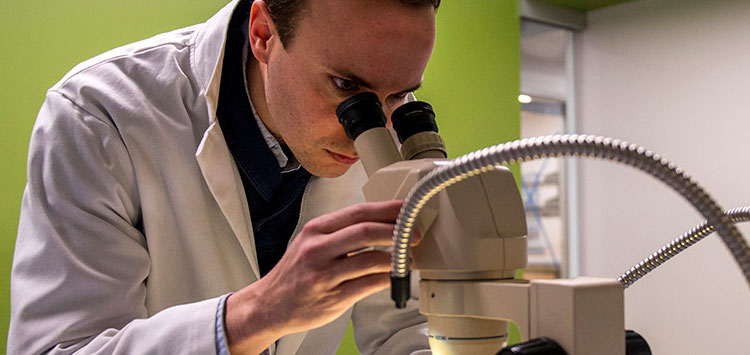
members and students use plankton nets and field microscopes to monitor for phytoplankton
that have the potential to cause harmful algal blooms (HABs also known as "red
tides"). This volunteer program was designed to act as an early warning system for
HABs, which may result in shellfish bed closures due to biotoxins. The volunteers
use data sheets to report the relative abundance of target species such as Alexandrium
spp., Dinophysis spp., Prorocentrum lima, and Pseudonitzschia spp. to
the DMR in real-time. This information is used by the DMR biotoxin monitoring program to
assist in prioritizing need of testing shellfish meat for biotoxins. Approximately 75
volunteers monitor 40 sites coast-wide on a weekly basis April through November.
Program Achievements
- Trained volunteers reliably notify the Maine Department of Marine
Resources when there are increases in potentially toxic phytoplankton cells present along
the coast of Maine.
- Education on harmful algae blooms is provided in 40 coastal
communities annually.
- Over 3,500 recorded observations of phytoplankton species in
database.
- Citizen participants range in age and background from high school
students to retired scientists.
- In the fall of 1999, a methodology for counting phytoplankton cells
was developed and is being utilized by one of the volunteer groups to provide information
about phytoplankton populations to finfish aquaculturists.
- In 1997-8, using information on the large Dinophysis populations
from the volunteer monitoring effort, a NOAA biotoxin team was assembled to determine if
diarrhetic shellfish poisoning (DSP) occurs along the coast of Maine.
This was the first
study demonstrating the possibility of DSP on the Maine coast. Since okadaic acid
(Dinophysis toxin-1) was detected in the dinoflagellate Prorocentrum lima, a
protocol for volunteer monitors to identify P. lima has been developed and the protocol,
after further field testing, will be implemented in the future.
Background and Need
For the success of Maine's shellfish resources, there needs
to be an active monitoring program that can pick out and observe toxic phytoplankton.
Phytoplankton species such as Alexandrium spp., Dinophysis spp., Prorocentrum
spp., or Pseudonitzschia spp. may pose a threat to shellfish
safety. These types of phytoplankton may "bloom" in a given area when conditions
are right, and an active monitoring project may be extremely effective in promoting
shellfish safety to the public by identifying these organisms and determining when they
are present.
If shellfish ingest the toxic phytoplankton they are not infected
themselves, but carry the marine biotoxin. If a human ingests the shellfish carrying the
toxin, it may result in sickness and, (depending on the toxin involved) some cases death
for the human.
In Maine, monitoring for marine biotoxins is conducted by
the Maine Department of Maine Resources (DMR), which monitors for Paralytic Shellfish
Poisoning (PSP) caused by Alexandrium spp. There are, however,
other toxic algae that could potentially be
present in Maine waters, for which monitoring is not generally conducted.
These algae include Pseudonitzschia spp., which causes
Amnesiac Shellfish Poisoning (ASP), and Dinophysis spp., which causes Diarrhetic
Shellfish Poisoning (DSP). Volunteer based monitoring efforts would prove to be an
integral part in harvesting safe shellfish and providing essential data on algae blooms,
which would aid the DMR in the methods currently used for quantifying marine biotoxins.
To become a
monitor,
contact
Alison Sirois
Department of Marine Resources
PO
Box 8, McKown Pt Rd
West
Boothbay, ME 04575
Wk:
207.633.9401 Fax: 207.633.9579
Alison.Sirois@maine.gov
Sponsors
University of Maine Cooperative
Extension,
Maine Sea Grant,
Maine Department of Marine Resources,
Bigelow Laboratory for Ocean
Sciences,
US Food and Drug Administration,
Gulf of Maine Council on the Marine Environment, and the
National Oceanic and
Atmospheric Administration.
|